
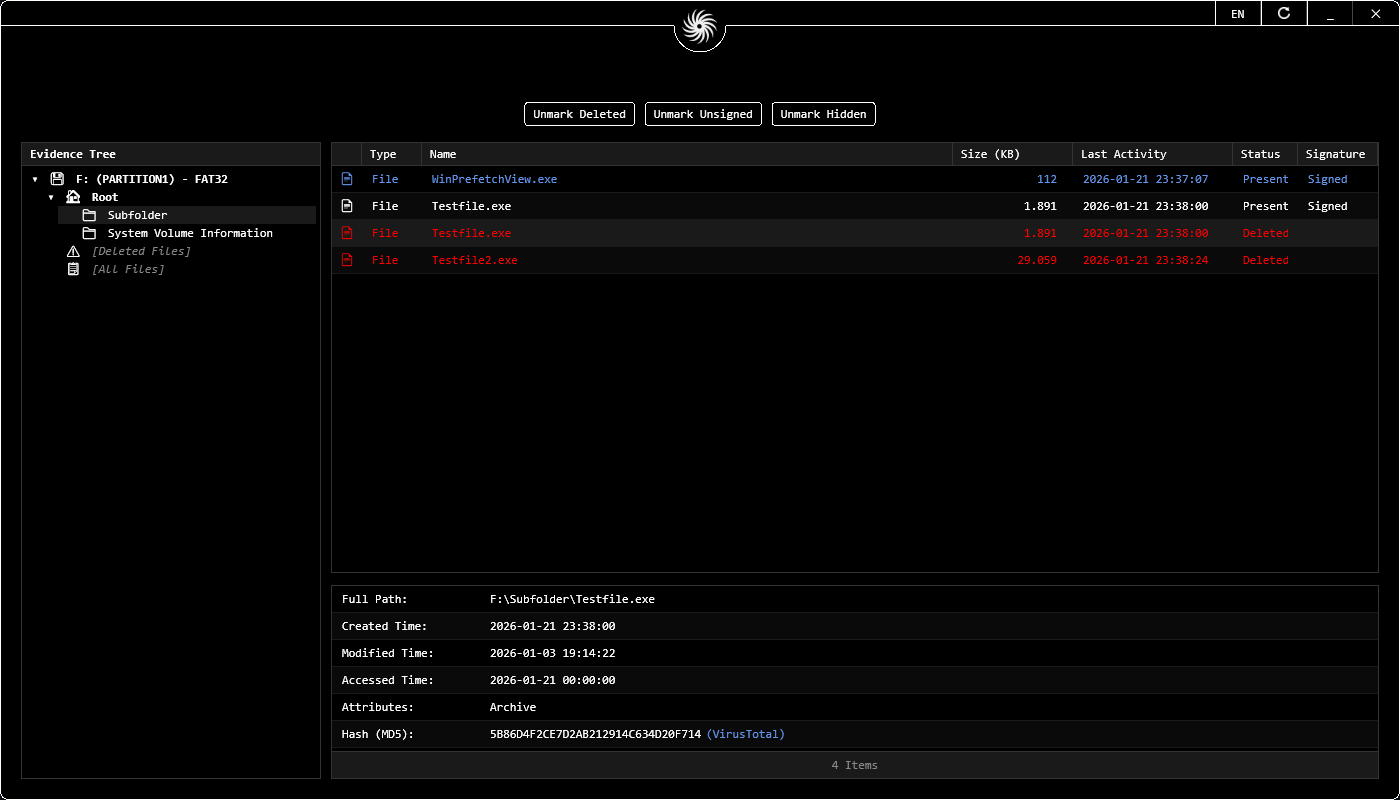
Forensic Significance of the FAT File System
While the New Technology File System (NTFS) is the standard for modern Windows system drives, the File Allocation Table (FAT) remains ubiquitous in digital forensics. From USB flash drives and SD cards to legacy hardware and specialized medical devices, FAT12, FAT16, and FAT32 are the go-to formats for portable storage. Vortex FAT is designed to provide examiners with a low-level view of these volumes, bypassing the operating system's abstraction layer to interact directly with the raw directory entries.
The primary forensic value of a FAT Tool lies in its simplicity—or rather, the
artifacts left behind by its simplicity. Unlike NTFS, which uses complex journaling and MFT records,
FAT relies on a simple table of clusters. When a file is deleted in a FAT system, the file's data
often remains perfectly intact; only the first character of the filename in the directory entry is
changed to a special hex value (0xE5). Vortex FAT automates the identification and
reconstruction of these "orphaned" entries, making deleted file recovery a
streamlined process.
Advanced Directory Entry Analysis
One of the most complex aspects of FAT forensics is the handling of Long File Names (LFN). Standard FAT entries only support the "8.3" naming convention (8 characters for the name, 3 for the extension). To support longer names, Windows uses a series of hidden "shadow" entries. A professional FAT parser must be able to link these fragmented entries back to the primary file record to present a coherent view to the investigator.
- Low-Level Volume Parsing: Access the boot sector and FAT tables directly to identify volume geometry and hidden partitions.
- Deleted File Identification: Automatically scan for
0xE5markers and assess the integrity of the associated cluster chain. - LFN Reconstruction: Piece together fragmented long filename entries to reveal the original identity of recovered files.
- Metadata Extraction: Capture creation, modification, and access timestamps that are often lost during simple file copies.
exFAT Forensic Tool & Raw Directory Entry Parser
Vortex FAT provides specialized handling as an exFAT Forensic Tool, supporting high-capacity SD cards and modern external drives. It functions as a Raw Directory Entry Parser to inspect the 32-byte records for hidden or malicious metadata.
- LFN Reconstruction Utility: Automatically reassemble Long File Names from fragmented "shadow" entries.
- FAT32 Recovery Software: Recover deleted files by tracking 0xE5 markers and cluster allocation chains.
- Cluster Chain Utility: Track the allocation of data across clusters to recover large, non-contiguous files.
- Volume Metadata Tool: Parse the specialized Boot Sector and Bitmap structures of FAT and exFAT volumes.
FAT & exFAT Forensic Support
| Feature | Forensic Value | Vortex Support |
|---|---|---|
| exFAT Parsing | High-capacity media analysis | Full Boot/Table Support |
| LFN Reconstruction | Recovering original file names | Automated Linking |
| 0xE5 Marker Scan | Identifying deleted entries | Deep Volume Carving |
| 8.3 SFN Analysis | Legacy filename artifacting | Raw Entry Access |
| Cluster Mapping | Data integrity verification | FAT Chain Tracking |
Note: For a detailed technical breakdown of FAT cluster chains and directory entry structures, visit our Forensic Repository.